What you get
Kumiko provides the common building blocks for a business app. Declare your features, then mount the built-in capabilities you need. They are included in the framework.
The core deal
Section titled “The core deal”Declare a feature, get the whole stack. One defineFeature() with an
entity gives you a Postgres table, typed API, validation, access rules, search,
and an admin UI with list, create, edit, and filter screens.
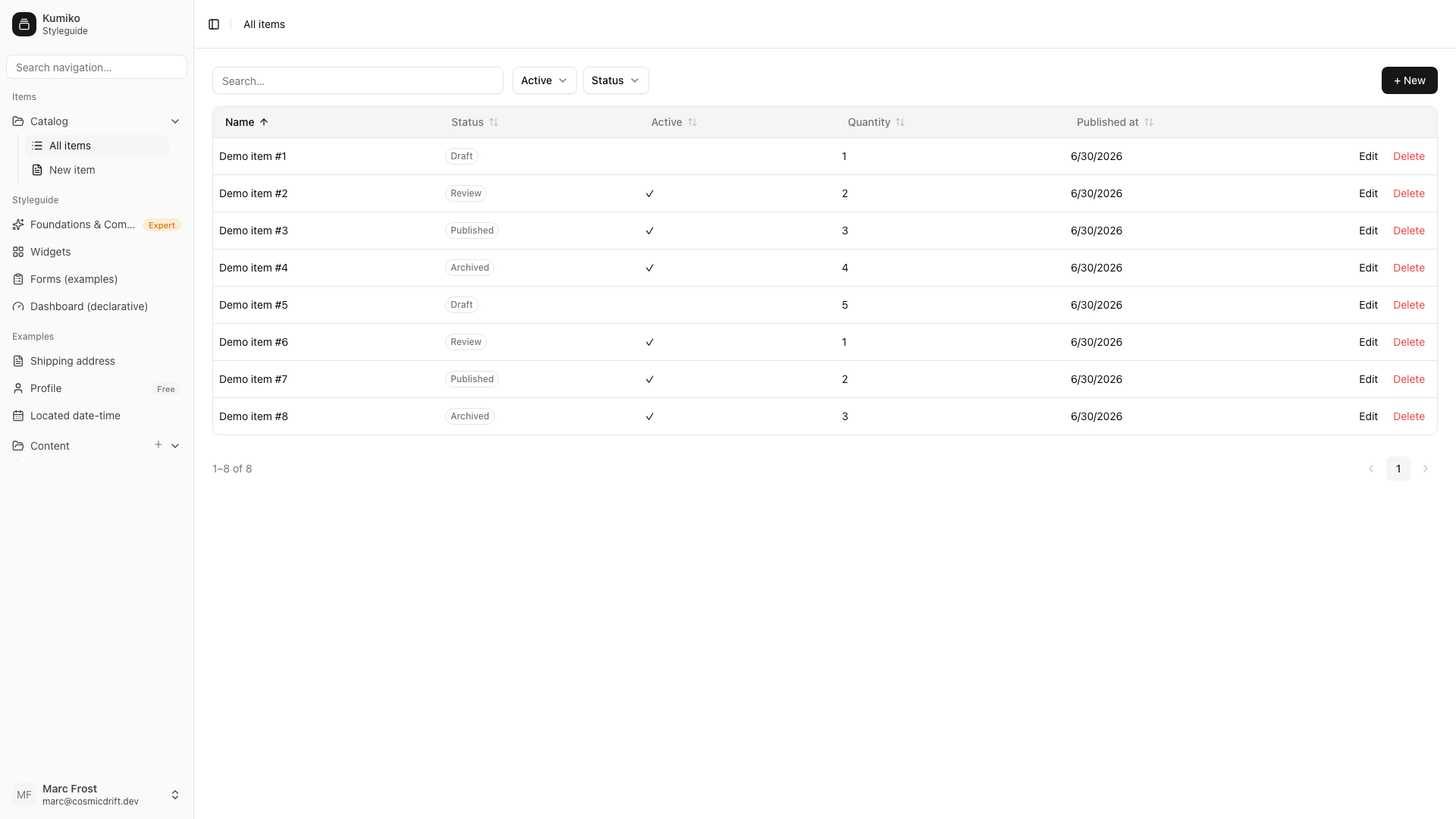
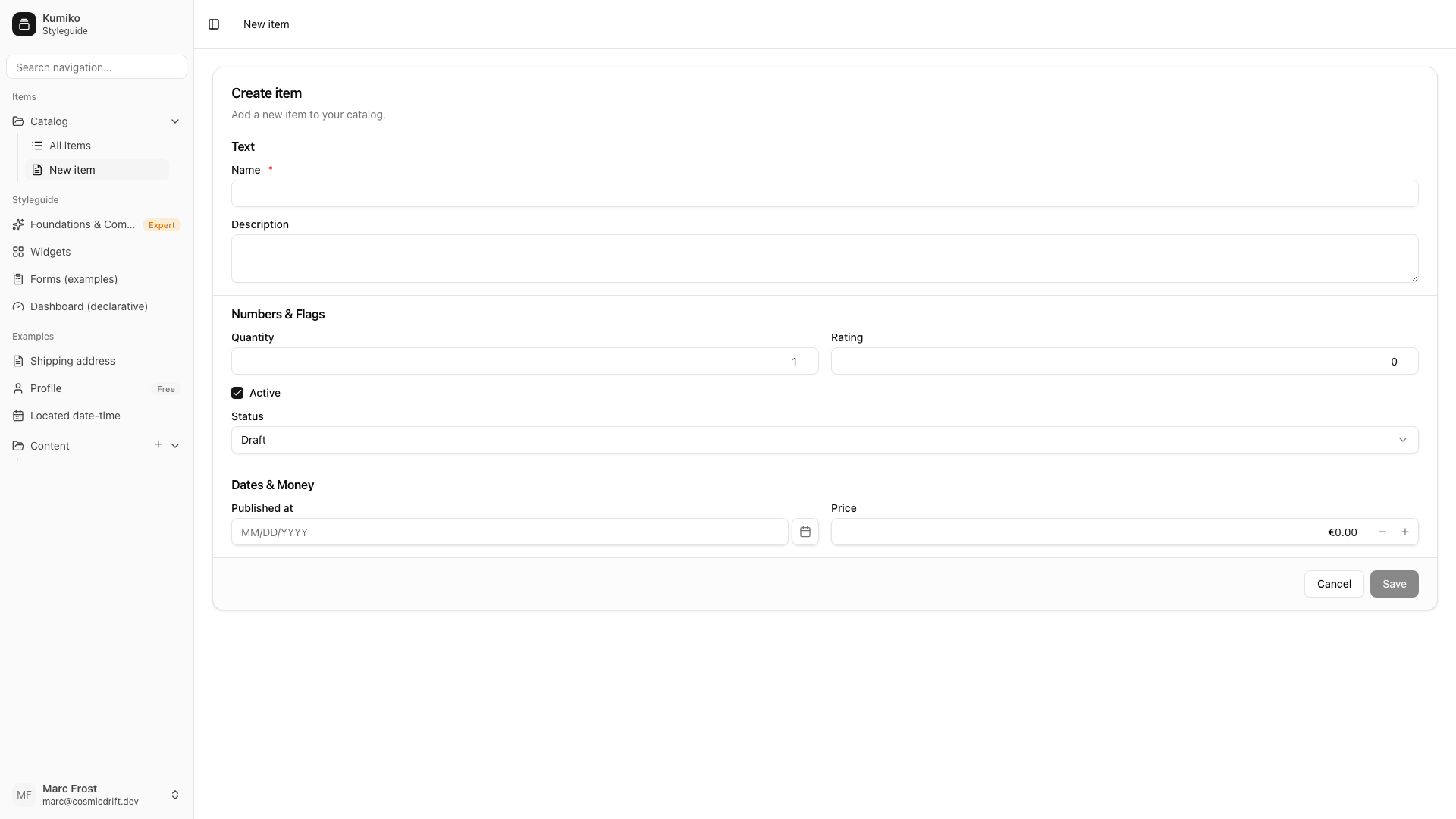
- Schema is the source of truth, change a field, and the table, API, forms, and labels follow. → Concepts: Schemas
- Realtime is the default, changes stream to every open browser over SSE, and concurrent edits are safe (optimistic locking), not an add-on.
- Audit comes built in, every write is an event; you get a full history and time-travel for free. → Concepts: Events
Built-in features
Section titled “Built-in features”These are pre-built features you mount in run-config.ts and configure :
you don’t write them. Each links to its reference page.
Identity & access
Section titled “Identity & access”- Users, tenants, sessions, multi-tenant accounts, tenant switching, and session lifecycle. → user, sessions
- Email + password auth, login, signup, password reset, email verification, and invites, all the screens included. → auth-email-password
- Feature toggles & plan tiers, gate features per tenant, enforce plan limits and usage caps. → feature-toggles, tier-engine
Communication & files
Section titled “Communication & files”- Notifications, one
ctx.notify(...)call delivers over email, push, and in-app, with templates, preferences, and a delivery log. → delivery - File storage, upload and serve files via S3 or local storage behind one API, with signed URLs. → files
Operations
Section titled “Operations”- Background jobs, register a worker, get scheduled and event-triggered runs with a persisted run history and operator retry. → jobs
- Rate limiting & audit, per-handler rate limits and an audit log for compliance reviews. → rate-limiting, audit
- Config & secrets, per-tenant config keys and tenant-scoped encrypted secrets. → config, secrets
Compliance & billing
Section titled “Compliance & billing”- GDPR tooling, data export (Art. 20), erasure (Art. 17), retention, and region profiles, wired end to end. → user-data-rights, compliance-profiles
- Subscriptions & billing, Stripe and Mollie behind one billing foundation. → subscription-stripe, subscription-mollie
An assistant that can use your app
Section titled “An assistant that can use your app”Your feature definitions already describe the app, entities, handlers, screens,
labels. agent-tools turns that registry into a tool catalog an LLM can call,
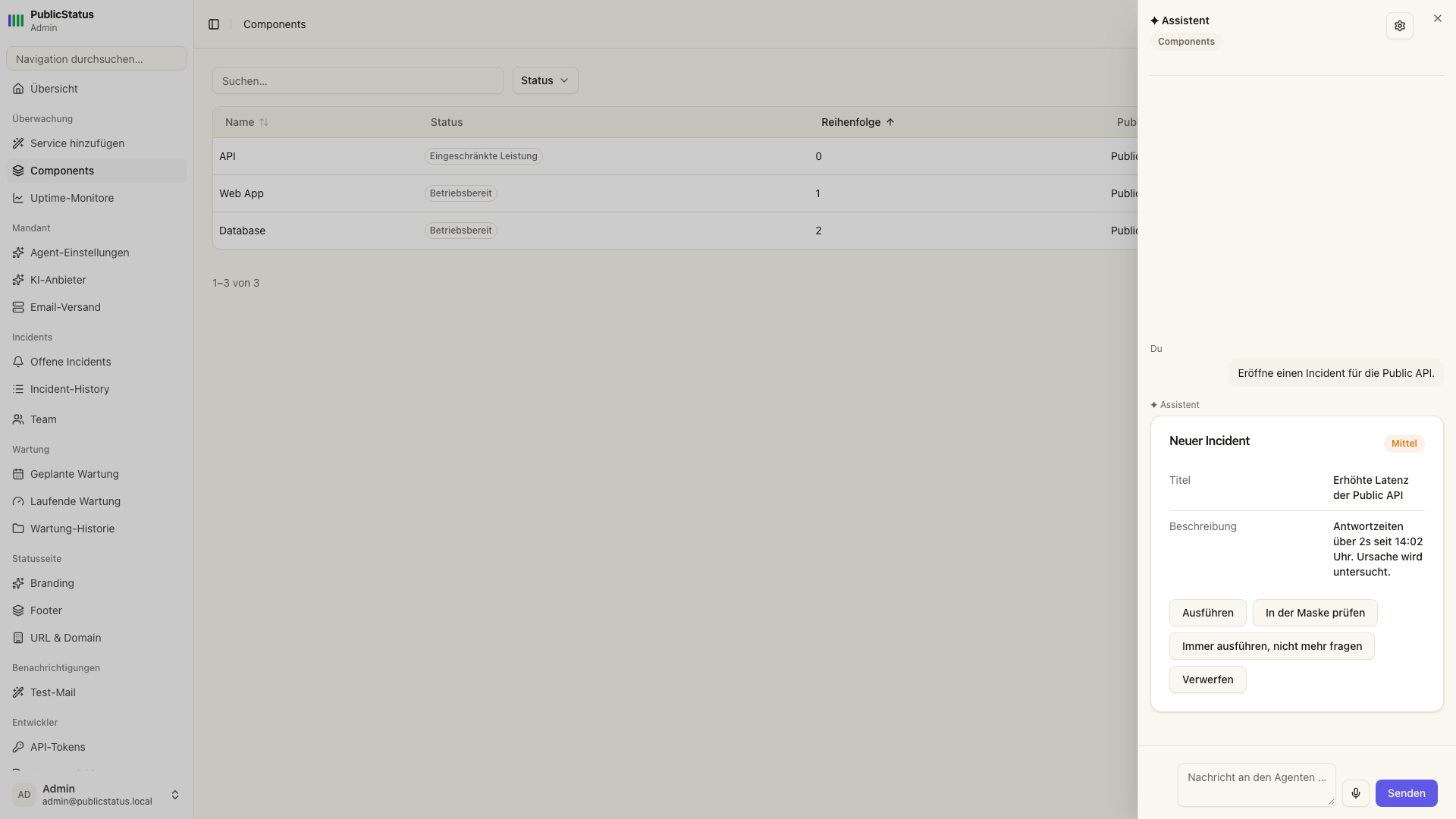
so a chat layer can search, open and change records instead of only talking
about them. Exposure is fail-closed: a handler without a description stays
invisible to the model, and a write is proposed for approval rather than
executed.
- Make your app agent-ready, the one sentence per handler,
agent.risk, the boot-time doc-gap check, and pre-seeded approval rules per tenant. → Guide: Make your app agent-ready - The chat surface itself is
ai-agent, part of Kumiko Enterprise, with a runnable ai-agent-basic recipe. - What it looks like in a running app, the proposal card, permission rules, modes and caps, voice, and what it deliberately is not. → The Assistant: talk to your app
See it running
Section titled “See it running”The capabilities above are easiest to grasp by running a real app:
- Marketing demo, an asset tracker and a helpdesk on one instance: the generated CRUD UI in full.
- ShowPony tutorial, build a guest-list app step by step.
- UI walkthrough, auth, tenant switching, language and theme toggles.
- publicstatus.eu, a full statuspage product built end to end on Kumiko, in production.
→ Ready to build your own? Quickstart, the starter includes a demo tasks UI out of the box. · Tutorial