Apex and subdomains
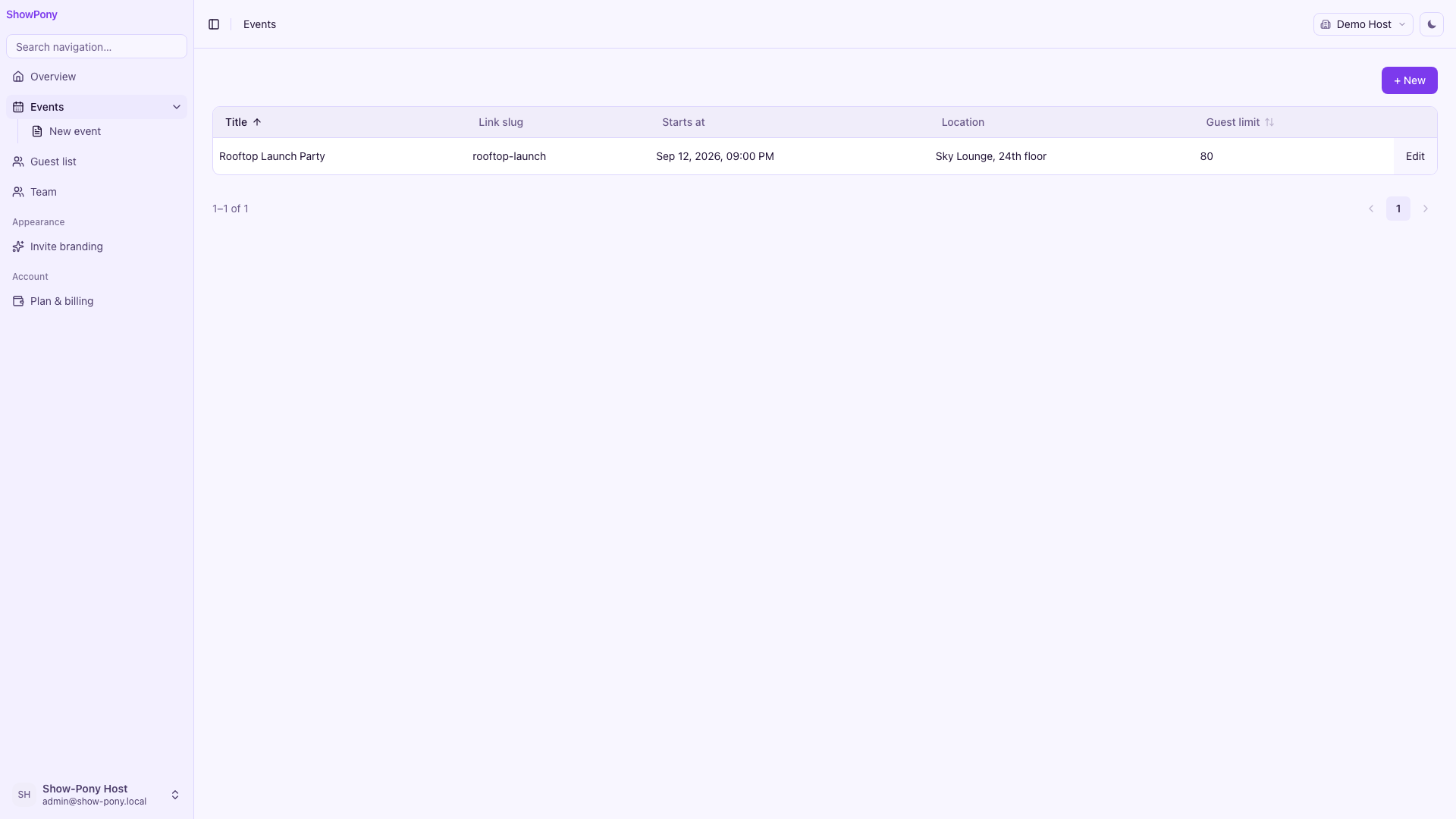
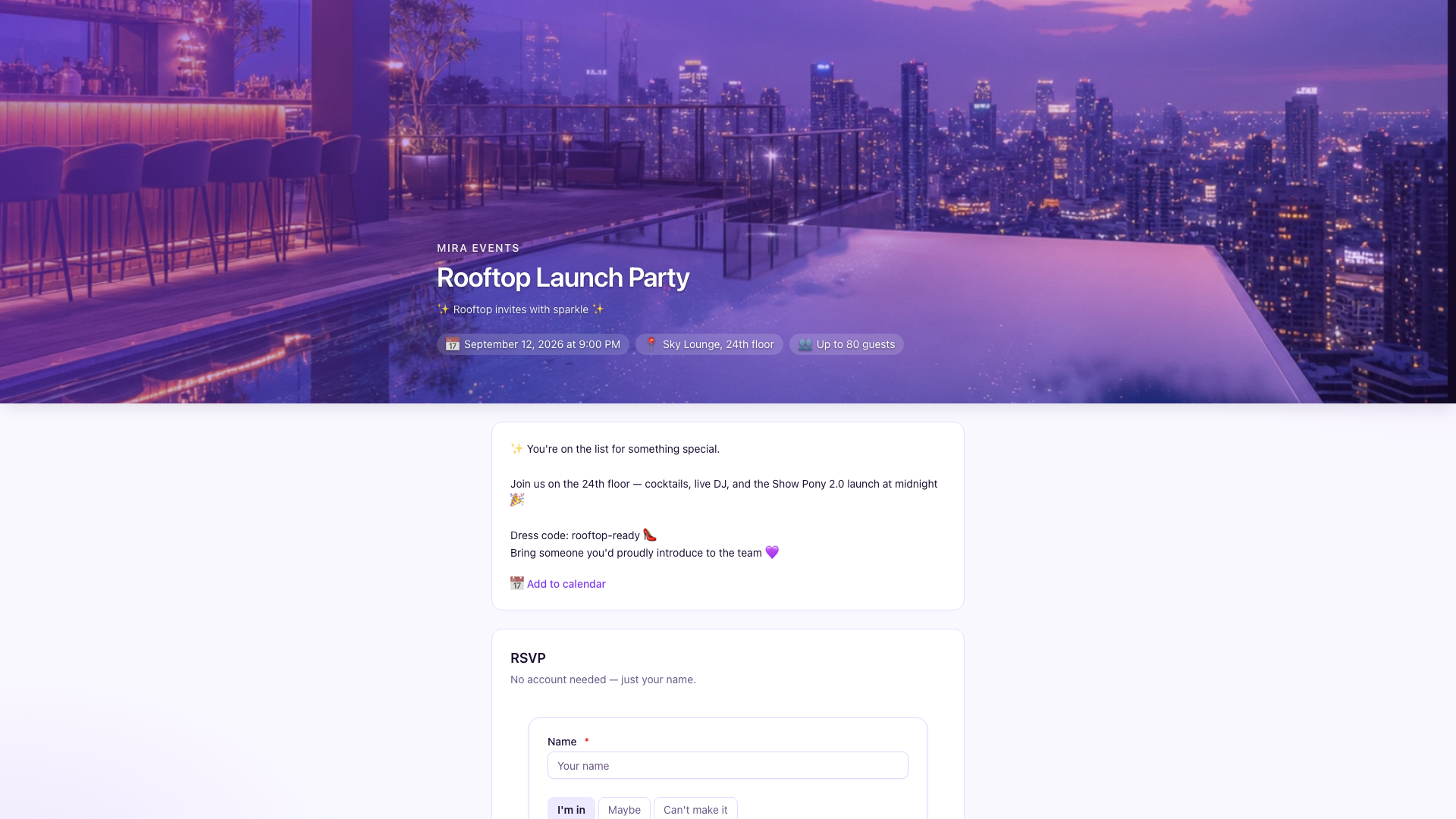
ShowPony serves two surfaces from one app:
| Host | Surface | Tenant |
|---|---|---|
show-pony.localhost:4180 (apex) | Host login + dashboard | none (null) |
demo.show-pony.localhost:4180 | Public RSVP page | tenant key demo |
| Surface | Local | Cloud |
|---|---|---|
| Host login (apex) | http://show-pony.localhost:4180/login | https://show-pony.kumiko.rocks/login |
| Demo invite (rooftop) | http://demo.show-pony.localhost:4180/e/rooftop-launch | https://demo.show-pony.kumiko.rocks/e/rooftop-launch |
| Acme invite (offsite) | http://acme.show-pony.localhost:4180/e/acme-offsite | https://acme.show-pony.kumiko.rocks/e/acme-offsite |
The host is decided by the subdomain a request arrives on, never by anything the guest sends. That is what makes a shared, anonymous app safe.
flowchart LR
  subgraph apex["apex : show-pony.localhost"]
    Landing[Marketing]
    Login[Login]
    Dash[Host dashboard]
  end
  subgraph demo["demo.show-pony.localhost"]
    Invite[Invite page]
    RSVP[Anonymous RSVP]
  end
  Guest((Guest)) --> Invite
  Invite --> RSVP
  Visitor((Visitor)) --> Landing
  Host((Host)) --> Login --> Dash
The same app process serves two HTML bundles. The server picks one by the Host
header:
Strip the hostname
Section titled “Strip the hostname”Port comes off the Host header first; then the subdomain suffix maps to
tenant.key:
export function hostnameOf(host: string): string {  const i = host.indexOf(":");  return i === -1 ? host : host.slice(0, i);}
// Apex / www: login, not a guest surface : no tenant.if (host === baseDomain || host === `www.${baseDomain}`) return null;// <key>.<baseDomain>: subdomain IS the tenant key.if (host.endsWith(`.${baseDomain}`)) { return enabledTenantByKey(db, host.slice(0, -(baseDomain.length + 1)));}src/tenant-routing.ts.
resolverTrust: "authoritative" is what actually closes this: a client-supplied
X-Tenant header that disagrees with the hostname-resolved tenant is rejected
with 400 tenant_mismatch before tenantExists ever runs. tenantExists alone
only proves a real, enabled row, not that it matches the subdomain.
Wire at boot
Section titled “Wire at boot”bin/server.ts passes the anonymous-access helper into the dev server (subdomain
resolver + SYSTEM tenant on the apex for /legal/*):
anonymousAccess: ({ db }) => createShowPonyAnonymousAccess({ db, baseDomain: BASE_DOMAIN }),bin/server.ts.
Production uses the same resolver shape in bin/main.ts with https origins.
Two bundles, routed by host
Section titled “Two bundles, routed by host”The apex serves static marketing pages (/, /de, /features, /pricing)
and the admin SPA at /login (and authenticated app routes). Every subdomain
serves index.html (public guest bundle). The server decides, rather than
client-side
hostname checks:
hostDispatch: (req) => { const host = hostnameOf(req.headers.get("host") ?? ""); const path = new URL(req.url).pathname; if (host === BASE_DOMAIN || host === `www.${BASE_DOMAIN}`) { const dispatched = dispatchShowPonyApexStaticDev(path); if (dispatched !== null) return dispatched; return { kind: "html", entryName: "admin", injectSchema: true }; } return { kind: "html", entryName: "public", injectSchema: false };},bin/server.ts.
The complete file
Section titled “The complete file”// Subdomain → host tenant. The anonymous RSVP write needs the tenant from the// request envelope (the Host header), never from the payload — otherwise a// guest could forge it. We map <key>.<baseDomain> straight onto the bundled// `tenant.key`, so there's no extra profile schema. Apex / www / unknown all// resolve to null (no tenant).//// createShowPonyAnonymousAccess is the shared implementation:// createShowPonyTenantRoutingFeature (auth-foundation providers, production// since #1374) builds both its resolver and existence plugin on it, and// isolated test stacks that inject Resolved callbacks without mounting// providers call it directly.//// tenantExists is the defense-in-depth check against a forged X-Tenant header:// only a real, enabled tenant row counts.
import { type AuthProviderBuildDeps, EXT_TENANT_EXISTENCE, EXT_TENANT_RESOLVER, type TenantExistenceProvider, type TenantExistsFn, type TenantResolverFn, type TenantResolverProvider,} from "@cosmicdrift/kumiko-bundled-features/auth-foundation";import { tenantTable } from "@cosmicdrift/kumiko-bundled-features/tenant";import type { DbConnection } from "@cosmicdrift/kumiko-framework/db";import { fetchOne } from "@cosmicdrift/kumiko-framework/db";import { defineFeature, type FeatureDefinition, isSystemTenant, type TenantId,} from "@cosmicdrift/kumiko-framework/engine";
// Strip the port: "acme.show-pony.localhost:4180" → "acme.show-pony.localhost".export function hostnameOf(host: string): string { const i = host.indexOf(":"); return i === -1 ? host : host.slice(0, i);}
type TenantRow = { id: TenantId; isEnabled: boolean };
async function enabledTenantByKey(db: DbConnection, key: string): Promise<TenantId | null> { const row = await fetchOne<TenantRow>(db, tenantTable, { key }); return row !== undefined && row.isEnabled === true ? row.id : null;}
async function isTenantEnabled(db: DbConnection, id: TenantId): Promise<boolean> { const row = await fetchOne<TenantRow>(db, tenantTable, { id }); return row !== undefined && row.isEnabled === true;}
export function createShowPonyTenantResolver(config: { db: DbConnection; baseDomain: string }) { const { db, baseDomain } = config; return { tenantResolver: async (c: { req: { header: (n: string) => string | undefined }; }): Promise<TenantId | null> => { const host = hostnameOf(c.req.header("Host") ?? ""); // Apex / www: the host's own login, not a guest surface — no tenant. if (host === baseDomain || host === `www.${baseDomain}`) return null; // <key>.<baseDomain>: the subdomain IS the tenant key. if (host.endsWith(`.${baseDomain}`)) { return enabledTenantByKey(db, host.slice(0, -(baseDomain.length + 1))); } return null; }, tenantExists: (id: TenantId): Promise<boolean> => isSystemTenant(id) ? Promise.resolve(true) : isTenantEnabled(db, id), // Host-derived, not client-controlled — see createShowPonyAnonymousAccess. resolverTrust: "authoritative" as const, };}
/** Apex anonymous routes (legal pages) need SYSTEM tenant; subdomains keep host tenant. */// Module-global singleton, not per-stack state: acceptable because// buildAppFeatures(...)/resolveApexTenant are wired once at static boot,// never per request, and this process only ever runs one app stack. Bind// BEFORE the first request that needs it (bindSubdomainPageResolver at// boot) — a second stack in the same process would silently share this db.let subdomainPageResolver: { db: DbConnection; baseDomain: string } | null = null;
/** Wire db for managed-pages `resolveApexTenant` (boot hook — wired once at static boot). */export function bindSubdomainPageResolver(config: { db: DbConnection; baseDomain: string }): void { subdomainPageResolver = config;}
/** Host → tenantId for managed-pages branding reads (subdomain = tenant.key). */export async function resolveSubdomainPageTenant(host: string): Promise<TenantId | null> { if (!subdomainPageResolver) return null; const { db, baseDomain } = subdomainPageResolver; const h = hostnameOf(host); if (h === baseDomain || h === `www.${baseDomain}`) return null; if (h.endsWith(`.${baseDomain}`)) { return enabledTenantByKey(db, h.slice(0, -(baseDomain.length + 1))); } return null;}
export function createShowPonyAnonymousAccess(config: { db: DbConnection; baseDomain: string }) { const subdomain = createShowPonyTenantResolver(config); const { baseDomain } = config; return { tenantResolver: async (c: { req: { header: (n: string) => string | undefined }; }): Promise<TenantId | null> => { const host = hostnameOf(c.req.header("Host") ?? ""); // Apex has no anonymous tenant: legal/marketing pages are pre-rendered // static HTML (renderAllMarketingPages) and branding reads go through // the separate resolveSubdomainPageTenant/bindSubdomainPageResolver // pipeline, not this resolver. Returning null here (not // SYSTEM_TENANT_ID) means an apex-origin anonymous /api/write or // /api/query — with or without an X-Tenant header — gets // "tenant_required" from the authoritative resolver instead of // silently landing on SYSTEM_TENANT_ID. if (host === baseDomain || host === `www.${baseDomain}`) return null; return subdomain.tenantResolver(c); }, tenantExists: subdomain.tenantExists, // Host-derived, not client-controlled — the resolver's answer is final. // A client-supplied X-Tenant header disagreeing with the subdomain (e.g. // a guest on acme.show-pony.<domain> claiming Globex's real tenant id) // is rejected with 400 tenant_mismatch instead of silently overriding // the subdomain (kumiko-platform#278/1 / #51). resolverTrust: "authoritative" as const, };}
export type ShowPonyTenantRoutingFeatureConfig = { readonly baseDomain: string;};
/** * Registers subdomain tenantResolver + tenantExists as auth-foundation * providers (#1374). Mount alongside auth-foundation; boot merges them into * anonymousAccess via resolveAnonymousAccessFromRegistry. */export function createShowPonyTenantRoutingFeature( config: ShowPonyTenantRoutingFeatureConfig,): FeatureDefinition { const { baseDomain } = config; return defineFeature("show-pony-tenant-routing", (r) => { r.requires("auth-foundation"); const resolverPlugin: TenantResolverProvider = { trust: "authoritative", build: (deps: AuthProviderBuildDeps) => { const built = createShowPonyAnonymousAccess({ db: deps.db, baseDomain }); return built.tenantResolver as TenantResolverFn; }, }; const existencePlugin: TenantExistenceProvider = { build: (deps: AuthProviderBuildDeps) => { const built = createShowPonyAnonymousAccess({ db: deps.db, baseDomain }); return built.tenantExists as TenantExistsFn; }, }; r.useExtension(EXT_TENANT_RESOLVER, "subdomain", resolverPlugin); r.useExtension(EXT_TENANT_EXISTENCE, "db", existencePlugin); });}📄 On GitHub: src/tenant-routing.ts
Next: define the entities that flow through these two surfaces: chapter 5. For the marketing apex itself see chapter 12 and chapter 13.