config
Stores per-tenant (and optionally per-user) configuration values with a multi-layer cascade: user-row → tenant-row → system-row → app-override (deploy-time AppConfigOverrides) → computed → feature default. Access a value in handlers via ctx.config(handle), declare keys with r.config({ keys: { ... } }) inside a feature’s registry callback, and optionally mark them encrypted: true to route storage through the envelope cipher (versioned master key). Use this feature whenever a tenant admin needs to customise behaviour at runtime without a code deploy.
Quick example
Section titled “Quick example”From recipes-encrypted-tenant-config — the smallest working mount:
// Encrypted per-tenant config — Stripe-API-key pattern.//// Minimal-Showcase: ein dummy "billing"-feature mit einem per-tenant// Stripe-API-Key. Der `mask`-Eintrag lässt den configEdit-Screen +// Settings-Hub-Nav automatisch entstehen (kein handgeschriebenes// r.screen/r.nav mehr). charge-handler liest den Key über ctx.config// (entschlüsselt automatisch).//// Production: nicht aufrufen — der echte Stripe-Call ist hier ein Mock.// Pattern in produktiven Apps: Strip-API-Key in tenantBillingConfig.key,// charge-handler lädt key + ruft tatsächlich Stripe.
import {  access,  type ConfigKeyHandle,  createTenantConfig,  defineFeature,  defineWriteHandler,} from "@cosmicdrift/kumiko-framework/engine";import { UnprocessableError, writeFailure } from "@cosmicdrift/kumiko-framework/errors";import { z } from "zod";
const FEATURE = "billing";
// Config-Key-Definition: encrypted=true → ciphertext in der DB. write/// read: access.admin damit nur Tenant-Admin den Key setzt + reads sind// nur backend-side via ctx.config (frontend sieht "••••••"). `mask` →// buildConfigFeatureSchema derivt Screen + Settings-Hub-Nav.const stripeApiKeyDef = createTenantConfig("text", {  encrypted: true,  write: access.admin,  read: access.admin,  // mask-derived screens carry no field constraints (maxLength, pattern) —  // set those separately in a configEdit schema if you need them enforced.  mask: { title: "billing.stripe-api-key", order: 1 },});
const stripeApiKeyHandle: ConfigKeyHandle<"text"> = {  name: `${FEATURE}:config:stripe-api-key`,  type: "text",};
// Charge-Handler — nutzt den entschlüsselten API-Key. Caller sieht NUR// die charge-id zurück, der Key bleibt server-side.const chargeHandler = defineWriteHandler({  name: "charge",  schema: z.object({    amount: z.number().positive(),    customerRef: z.string().min(1),  }),  access: { roles: ["Admin"] },  async handler(event, ctx) {    if (!ctx.config) {      return writeFailure(        new UnprocessableError("config_unavailable", {          i18nKey: "billing.errors.configUnavailable",        }),      );    }    const apiKey = await ctx.config(stripeApiKeyHandle);    if (!apiKey || apiKey.length === 0) {      return writeFailure(        new UnprocessableError("stripe_key_missing", {          i18nKey: "billing.errors.stripeKeyMissing",        }),      );    }
    // Mock: real impl würde fetch("https://api.stripe.com/v1/charges",    // { headers: { Authorization: `Bearer ${apiKey}` }, ... }) ausführen.    // Wichtig: apiKey verlässt den server NICHT — kein log, kein    // response-field, kein error-detail.    const chargeId = `ch_${Date.now()}_${event.payload.customerRef}`;
    return {      isSuccess: true as const,      data: { chargeId },    };  },});
export const billingFeature = defineFeature(FEATURE, (r) => {  r.requires("config");  r.config("stripe-api-key", stripeApiKeyDef);  r.writeHandler(chargeHandler);  // Kein r.screen/r.nav: der `mask`-Eintrag auf dem Key lässt  // buildConfigFeatureSchema den configEdit-Screen (••••••-maskiert,  // config:write:set verschlüsselt vor dem write) + den Settings-Hub-Nav  // automatisch ableiten.
  r.translations({    keys: {      "billing.settings": { de: "Abrechnung", en: "Billing" },      "billing.stripe-api-key": { de: "Stripe-API-Schlüssel", en: "Stripe API Key" },    },  });});
// Re-exports damit tests die handles ohne re-typing nutzen können.export { stripeApiKeyHandle };
📄 On GitHub: samples/recipes/encrypted-tenant-config/src/feature.ts
Live preview
Section titled “Live preview”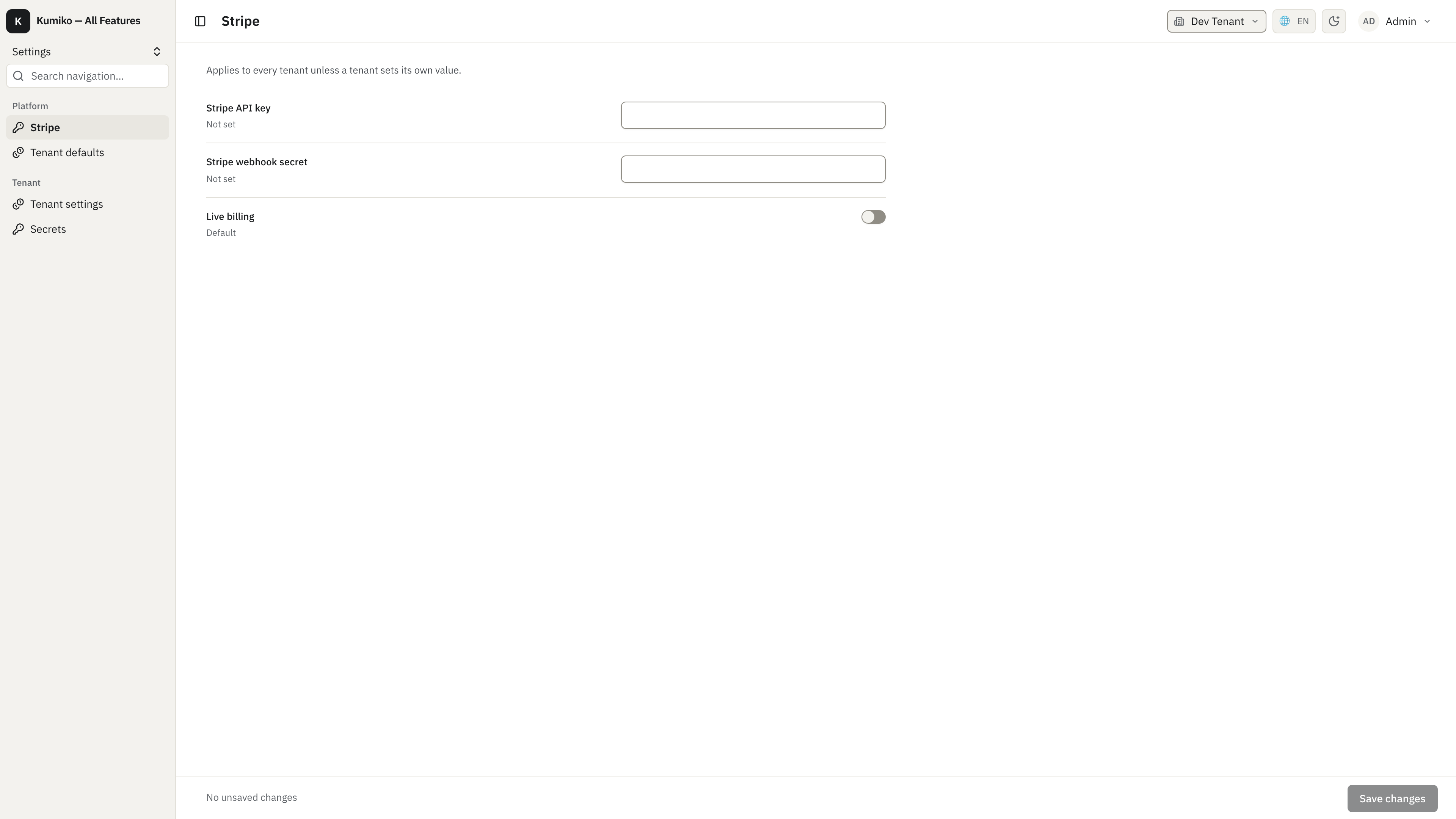
How it fits
Section titled “How it fits”The write commands this feature provides (Provides).
flowchart TB
  n_config["config"]
  subgraph how_provides["Provides"]
    n_cmd_config_write_reset(["reset"])
    n_cmd_config_write_set(["set"])
  end
  n_config --> n_cmd_config_write_reset
  n_config --> n_cmd_config_write_set
Provides — write commands this feature registers (dispatch them through the command bus):
Getting started
Section titled “Getting started”Start with recipes-encrypted-tenant-config for a step-by-step walkthrough with runnable code and integration tests.
Dependencies
Section titled “Dependencies”- Requires: none
- Activation: always on (not toggleable)