Anonymous RSVP
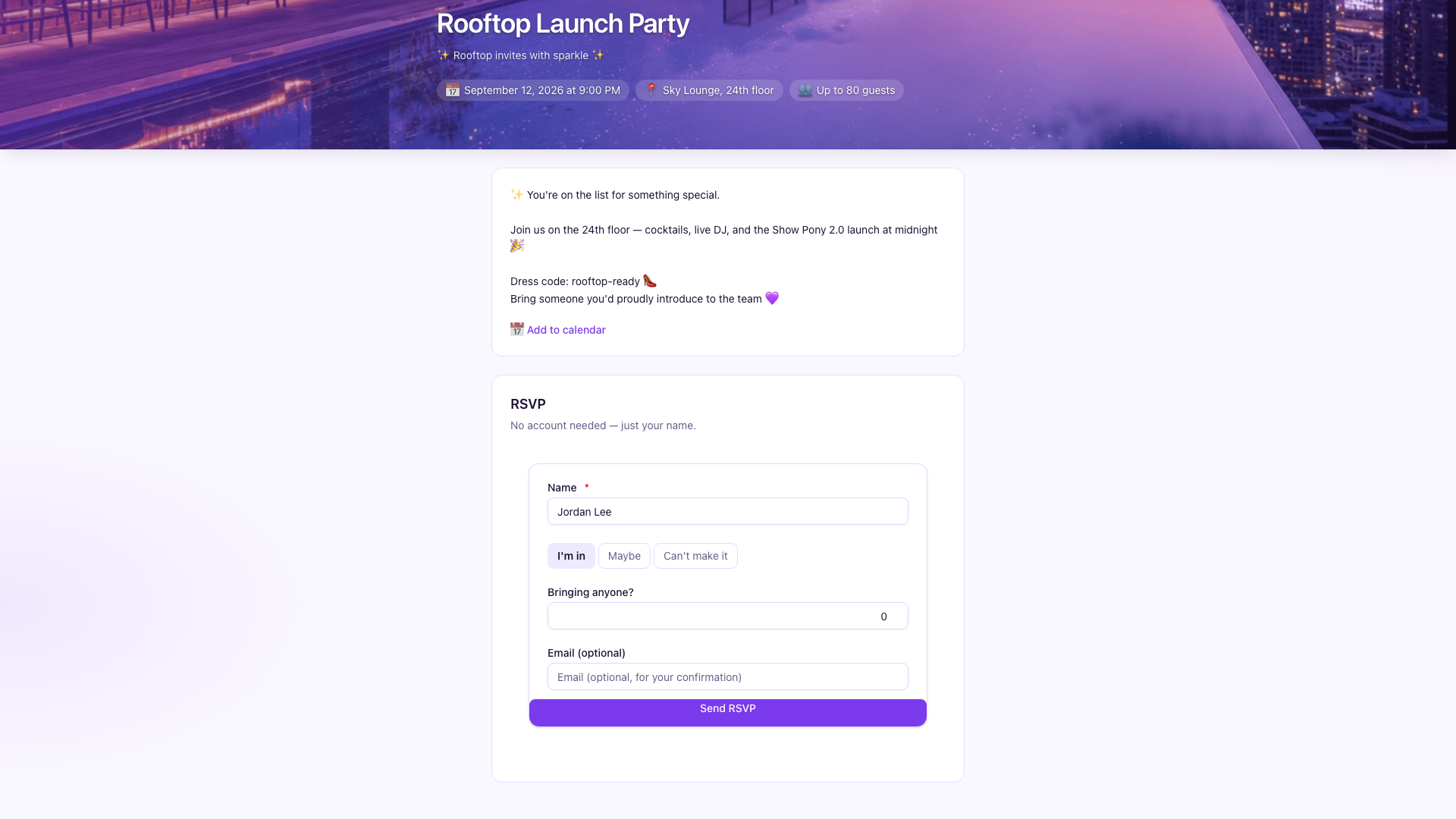
A guest opens demo.show-pony.localhost:4180/e/rooftop-launch, types a name, and
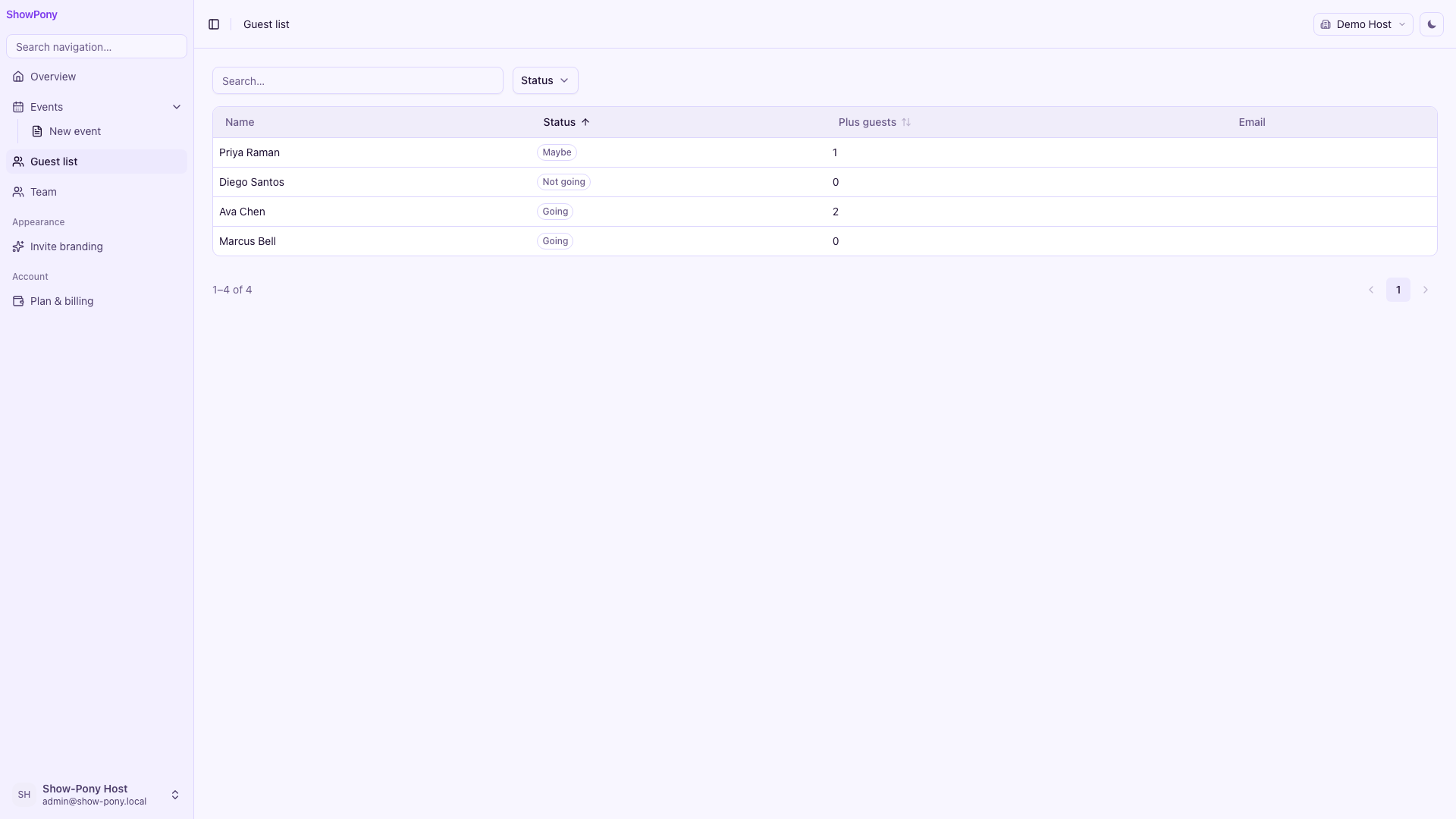
submits. No account. The server must land that row on Demo Host’s guest list,
not another tenant’s. The trap is letting the form send a tenant id; ShowPony never
does.
Let the guest through
Section titled “Let the guest through”A handler is public when its access list includes the anonymous role:
export const rsvpSubmitHandler = defineWriteHandler({ name: "rsvp:submit", schema: rsvpSubmitSchema, access: { roles: [...access.anonymous] }, rateLimit: { per: "ip+handler", limit: 20, windowSeconds: 60 }, handler: async (event, ctx) => { const result = await rsvpExecutor.create(event.payload, event.user, ctx.db); await sendRsvpConfirmation(ctx, event.user.tenantId, event.payload).catch(() => undefined); return result; },});src/features/show-pony/handlers/rsvp-submit.write.ts (tier cap check omitted).
The per-IP rate limit is mandatory: every anonymous caller shares
user.id === "anonymous". A per-user limit would be one global tap.
The tenant comes from chapter 4. The subdomain on the request, not the payload.

Does it actually hold?
Section titled “Does it actually hold?”The integration test runs the real createShowPonyAnonymousAccess (the
same factory bin/server.ts wires) against two
seeded tenants:
- RSVP to
acme.show-pony.test→ Acme’s list only;globex.…→ Globex only - Unknown subdomain →
400 tenant_required - Forged
X-Tenant(unknown id, or a real other tenant’s id) →400 tenant_mismatch; the resolver’s tenant is never overridden event:createas anonymous →403
bun --env-file=.env test src/__tests__/rsvp-anonymous.integration.test.tsRound trip
Section titled “Round trip”- Host creates event on apex (chapter 6).
- Guest opens the demo invite URL (local or cloud; see table below).
- Guest submits → row appears on host’s RSVP list.
| Surface | Local | Cloud |
|---|---|---|
| Host login (apex) | http://show-pony.localhost:4180/login | https://show-pony.kumiko.rocks/login |
| Demo invite (rooftop) | http://demo.show-pony.localhost:4180/e/rooftop-launch | https://demo.show-pony.kumiko.rocks/e/rooftop-launch |
| Acme invite (offsite) | http://acme.show-pony.localhost:4180/e/acme-offsite | https://acme.show-pony.kumiko.rocks/e/acme-offsite |
The complete test file
Section titled “The complete test file”// The core proof: an anonymous RSVP write lands deterministically on the host// tenant resolved from the subdomain (Host header) — never on the wrong one.// That's the gap show-pony fills as a sample.//// We mount the REAL production host routing (FW host-routing feature, the same// options bin/main.ts/bin/server.ts use) against real tenant rows —// subdomain→key lookup AND the tenantExists guard against a forged X-Tenant// header are both covered, not just the framework pipeline.
import { afterAll, beforeAll, beforeEach, describe, expect, test } from "bun:test";import { createChannelEmailFeature, createInMemoryTransport,} from "@cosmicdrift/kumiko-bundled-features/channel-email";import { configValuesTable, createConfigAccessorFactory, createConfigFeature, createConfigResolver,} from "@cosmicdrift/kumiko-bundled-features/config";import { createDeliveryFeature, createDeliveryTestContext,} from "@cosmicdrift/kumiko-bundled-features/delivery";import { createManagedPagesFeature } from "@cosmicdrift/kumiko-bundled-features/managed-pages";import { seedNotificationTemplates } from "@cosmicdrift/kumiko-bundled-features/template-resolver/seeding";import { composeRendererStack } from "@cosmicdrift/kumiko-dev-server/compose-stacks";import { asRawClient } from "@cosmicdrift/kumiko-framework/db";import type { SessionUser } from "@cosmicdrift/kumiko-framework/engine";import { seedTenant, setupAppTestStack } from "@cosmicdrift/kumiko-testing";import { type TestStack, unsafePushTables } from "@cosmicdrift/kumiko-testing/stack";import { rsvpTable, showPonyFeature } from "../features/show-pony/feature";import { tierAssignmentTable } from "../features/show-pony/tier-resolver";import { hostRoutingAnonymousAccess, hostRoutingFeatures } from "./host-routing-stack";
const configResolver = createConfigResolver();const emailTransport = createInMemoryTransport();
const BASE_DOMAIN = "show-pony.test";const EVENT_ID = "00000000-0000-4000-8000-0000000000e1";
let stack: TestStack;let acmeId: string;let globexId: string;let acmeHostname: string;let globexHostname: string;let acmeEventId: string;let globexEventId: string;let acmeHost: SessionUser;let globexHost: SessionUser;
function submit( host: string, payload: Record<string, unknown>, extraHeaders: Record<string, string> = {},) { return stack.http.raw( "POST", "/api/write", { type: "showpony:write:rsvp:submit", payload }, { Host: host, ...extraHeaders }, );}
beforeAll(async () => { stack = await setupAppTestStack( [ ...hostRoutingFeatures(BASE_DOMAIN), createConfigFeature(), createManagedPagesFeature({ resolveApexTenant: async () => null }), ...composeRendererStack(), createDeliveryFeature(), createChannelEmailFeature({ transport: emailTransport, resolveEmail: async () => null }), showPonyFeature, ], { ...hostRoutingAnonymousAccess, extraContext: (deps) => ({ ...createDeliveryTestContext(deps), configResolver, _configAccessorFactory: createConfigAccessorFactory(deps.registry, configResolver), }), }, ); await unsafePushTables(stack.db, { configValuesTable, tier_assignments: tierAssignmentTable, }); // setupAppTestStack runs no boot seeds; the mail renders from the seeded system template. await seedNotificationTemplates(stack.db, stack.registry); // Subdomain routing resolves the tenant via a real DB lookup by key // (tenant-routing.ts enabledTenantByKey) — needs persisted rows. const acme = await seedTenant(stack, { name: "Acme", persist: true }); const globex = await seedTenant(stack, { name: "Globex", persist: true }); acmeId = acme.id; globexId = globex.id; acmeHostname = `${acme.key}.${BASE_DOMAIN}`; globexHostname = `${globex.key}.${BASE_DOMAIN}`; acmeHost = (await acme.addUser(["Admin"])).session; globexHost = (await globex.addUser(["Admin"])).session;
// The rsvp:submit event-existence guard rejects any // eventId that doesn't resolve to a real, tenant-scoped event row — every // test that expects a submit to actually reach the handler needs one. const acmeEvent = await stack.http.writeOk<{ id: string }>( "showpony:write:event:create", { title: "Rooftop Launch Party", slug: "rooftop-launch-mail-test", startsAt: "2026-09-12T19:00:00.000Z", guestLimit: 50, }, acmeHost, ); acmeEventId = acmeEvent.id;
const globexEvent = await stack.http.writeOk<{ id: string }>( "showpony:write:event:create", { title: "Globex Kickoff", slug: "globex-kickoff", startsAt: "2026-09-13T19:00:00.000Z", guestLimit: 50, }, globexHost, ); globexEventId = globexEvent.id;});
afterAll(async () => stack?.cleanup());
beforeEach(async () => { await asRawClient(stack.db).unsafe(`DELETE FROM "${rsvpTable.tableName}"`); emailTransport.sent.length = 0;});
describe("anonymous multi-tenant RSVP write (real resolver)", () => { test("RSVP lands on the host tenant resolved from the subdomain", async () => { const acme = await submit(acmeHostname, { eventId: acmeEventId, name: "Alice", status: "yes", plusN: 1, }); expect(acme.status).toBe(200);
const globex = await submit(globexHostname, { eventId: globexEventId, name: "Bob", status: "maybe", }); expect(globex.status).toBe(200);
// Each host sees only its own guest through the tenant-scoped guest list. const acmeList = await stack.http.query("showpony:query:rsvp:list", {}, acmeHost); const acmeBody = (await acmeList.json()) as { data: { rows: Array<{ name: string }> } }; expect(acmeBody.data.rows.map((r) => r.name)).toEqual(["Alice"]);
const globexList = await stack.http.query("showpony:query:rsvp:list", {}, globexHost); const globexBody = (await globexList.json()) as { data: { rows: Array<{ name: string }> } }; expect(globexBody.data.rows.map((r) => r.name)).toEqual(["Bob"]); });
test("unknown but well-formed eventId → 404 not_found, no rsvp row is created", async () => { const res = await submit(acmeHostname, { eventId: "00000000-0000-4000-8000-0000000000ff", name: "Ghost", status: "yes", }); expect(res.status).toBe(404); const body = (await res.json()) as { error: { code: string } }; expect(body.error.code).toBe("not_found");
const acmeList = await stack.http.query("showpony:query:rsvp:list", {}, acmeHost); const acmeBody = (await acmeList.json()) as { data: { rows: Array<{ name: string }> } }; expect(acmeBody.data.rows.map((r) => r.name)).not.toContain("Ghost"); });
test("Globex's real eventId submitted on Acme's subdomain → 404 not_found, tenant-scoped guard excludes foreign tenants", async () => { const res = await submit(acmeHostname, { eventId: globexEventId, name: "Mallory", status: "yes", }); expect(res.status).toBe(404); const body = (await res.json()) as { error: { code: string } }; expect(body.error.code).toBe("not_found");
const acmeList = await stack.http.query("showpony:query:rsvp:list", {}, acmeHost); const acmeBody = (await acmeList.json()) as { data: { rows: Array<{ name: string }> } }; expect(acmeBody.data.rows.map((r) => r.name)).not.toContain("Mallory"); });
test("unknown subdomain → 400 tenant_required (resolver returned null)", async () => { const res = await submit("nope.show-pony.test", { eventId: EVENT_ID, name: "Ghost", status: "yes", }); expect(res.status).toBe(400); const body = (await res.json()) as { error: { code: string } }; expect(body.error.code).toBe("tenant_required"); });
test("forged X-Tenant header (unknown id) → 400 tenant_mismatch, resolver's tenant is NOT overridden", async () => { // resolverTrust: "authoritative" rejects ANY client tenant that // disagrees with the subdomain-resolved one before tenantExists ever // runs — the mismatch check fires first, so this is now tenant_mismatch // rather than the old tenant_not_found (which only proved the *unknown* // id was rejected, never that a REAL other tenant's id would be too). const res = await submit( acmeHostname, { eventId: EVENT_ID, name: "Mallory", status: "yes" }, { "X-Tenant": "00000000-0000-4000-8000-deadbeefdead" }, ); expect(res.status).toBe(400); const body = (await res.json()) as { error: { code: string } }; expect(body.error.code).toBe("tenant_mismatch"); });
test("forged X-Tenant = Globex's REAL tenant id on acme's subdomain → 400 tenant_mismatch, RSVP does NOT land in Globex (#51)", async () => { // A guest on // acme.show-pony.test claims a real, active, OTHER tenant's id via the // header — not a garbage id tenantExists would catch anyway. Before // resolverTrust: "authoritative" this landed the RSVP in Globex's // guest list while served on Acme's subdomain (source="header" won // resolveTenant's precedence). Now the resolver (Acme, from the host) // is authoritative and a disagreeing client tenant is rejected outright. const res = await submit( acmeHostname, { eventId: EVENT_ID, name: "Mallory", status: "yes" }, { "X-Tenant": globexId }, ); expect(res.status).toBe(400); const body = (await res.json()) as { error: { code: string } }; expect(body.error.code).toBe("tenant_mismatch");
// Belt-and-suspenders: prove it structurally, not just via the status // code — Globex's guest list must still be empty. const globexList = await stack.http.query("showpony:query:rsvp:list", {}, globexHost); const globexBody = (await globexList.json()) as { data: { rows: Array<{ name: string }> } }; expect(globexBody.data.rows).toHaveLength(0); });
test("host CRUD rejects anonymous callers (event:create stays gated)", async () => { const res = await stack.http.raw( "POST", "/api/write", { type: "showpony:write:event:create", payload: { title: "Party", slug: "party" } }, { Host: acmeHostname }, ); expect(res.status).toBe(401); });
test("apex host + X-Tenant → 400 tenant_required (apex resolves to no tenant)", async () => { // Proves the apex branch of the host-routing resolver (show-pony sets no // apexAnonymousTenantId): the apex resolver returns null — no anonymous tenant // exists at apex, legal/marketing pages are static and branding reads // go through the separate resolveSubdomainPageTenant pipeline. With // resolverTrust: "authoritative" a resolver returning null never falls // back to a client-supplied X-Tenant, so this 400s as tenant_required, // same as the header-less case below. const res = await submit( BASE_DOMAIN, { eventId: EVENT_ID, name: "Mallory", status: "yes" }, { "X-Tenant": acmeId }, ); expect(res.status).toBe(400); const body = (await res.json()) as { error: { code: string } }; expect(body.error.code).toBe("tenant_required"); });
test("apex host, no X-Tenant → 400 tenant_required (no silent SYSTEM_TENANT_ID write)", async () => { // Regression pin: before this fix, an apex-origin anonymous write with // no X-Tenant header at all silently landed on SYSTEM_TENANT_ID (200, // real row written) — the only things stopping it in production were // DEMO_READ_ONLY + the origin guard upstream, neither of which this // test stack exercises. The resolver itself must reject it. const res = await submit(BASE_DOMAIN, { eventId: EVENT_ID, name: "Mallory", status: "yes" }); expect(res.status).toBe(400); const body = (await res.json()) as { error: { code: string } }; expect(body.error.code).toBe("tenant_required"); });});
describe("guest confirmation mail (notification template)", () => { test("sends the confirmation to the guest with the event title and the answer", async () => { const res = await submit(acmeHostname, { eventId: acmeEventId, name: "Zelda Quuxington", email: "alice@example.com", status: "yes", }); expect(res.status).toBe(200);
expect(emailTransport.sent).toHaveLength(1); const mail = emailTransport.sent[0]; expect(mail?.to).toBe("alice@example.com"); expect(mail?.subject).toBe('Your RSVP for "Rooftop Launch Party"'); expect(mail?.html).toContain("Rooftop Launch Party"); expect(mail?.html).toContain("Coming"); expect(mail?.text).toContain("Rooftop Launch Party"); expect(mail?.text).toContain("Coming"); });
test("renders the German template for a German guest", async () => { await submit( acmeHostname, { eventId: acmeEventId, name: "Gast", email: "gast@example.com", status: "no" }, { "X-Locale": "de" }, ); const mail = emailTransport.sent[0]; expect(mail?.subject).toBe("Deine Antwort für „Rooftop Launch Party“"); expect(mail?.text).toContain("Ich komme nicht"); });
test("keeps the unverified guest name out of the mail", async () => { await submit(acmeHostname, { eventId: acmeEventId, name: "Zelda Quuxington", email: "mallory@example.com", status: "maybe", }); const mail = emailTransport.sent[0]; expect(mail).toBeDefined(); expect(`${mail?.subject}${mail?.html}${mail?.text}`).not.toContain("Zelda"); });
test("escapes HTML in the event title — no injection into the mail body", async () => { // The free tier caps at one event per tenant, so the existing event is renamed and restored. const retitle = async (title: string) => { const { version } = await stack.http.queryOk<{ version: number }>( "showpony:query:event:detail", { id: acmeEventId }, acmeHost, ); await stack.http.writeOk( "showpony:write:event:update", { id: acmeEventId, version, changes: { title } }, acmeHost, ); }; await retitle("<script>alert(1)</script>"); try { await submit(acmeHostname, { eventId: acmeEventId, name: "Mallory", email: "mallory@example.com", status: "yes", }); } finally { await retitle("Rooftop Launch Party"); } const mail = emailTransport.sent[0]; expect(mail?.html).toContain("<script>"); expect(mail?.html).not.toContain("<script>"); });
test("the mail names the event of the tenant the guest replied to", async () => { await submit(globexHostname, { eventId: globexEventId, name: "Bob", email: "bob@example.com", status: "yes", }); expect(emailTransport.sent.map((mail) => mail.subject)).toEqual([ 'Your RSVP for "Globex Kickoff"', ]); });
test("no mail when the guest skips the email field", async () => { const res = await submit(acmeHostname, { eventId: acmeEventId, name: "Bob", status: "maybe", }); expect(res.status).toBe(200); expect(emailTransport.sent).toHaveLength(0); });
test("no mail when the RSVP is rejected", async () => { const res = await submit(acmeHostname, { eventId: globexEventId, name: "Mallory", email: "mallory@example.com", status: "yes", }); expect(res.status).toBe(404); expect(emailTransport.sent).toHaveLength(0); });});📄 On GitHub: rsvp-anonymous.integration.test.ts