Kumiko Enterprise
Enterprise Kumiko Enterprise brings AI into the business app itself. The commercial features sit on the open framework and connect to the same registry, handlers, permissions, tenants, jobs, and audit trail that your app already uses. Talk to us about access.
Each feature card below links a generated reference page (config keys, dependencies, secrets), the same drift-free tables as the bundled features, introspected from the booted registry.
Start with the AI workflows
Section titled “Start with the AI workflows”Choose the workflow that matches the product problem:
| You want to… | Start here | What it gives you |
|---|---|---|
| Let users ask questions and propose changes in the running app | The Assistant | Role-filtered tools, approval cards, tenant policy, caps, voice, and audit |
| Turn a natural-language feature idea into typed Kumiko source | ai-generate | A generated feature file with a compile-validation loop and human review |
| Change an existing feature with a focused request | ai-patch | Reviewable PatternChange[] edits instead of an opaque rewrite |
| Extract structured data from documents | ai-extract | JSON-Schema-shaped output for invoices, contracts, receipts, and similar inputs |
| Route inbound messages or tickets | ai-triage | Categories, sentiment, urgency, and proposed next actions |
| Tune a pipeline without redeploying code | ai-pipeline | Tenant policy, drafts, activation, rollback, golden fixtures, and dry runs |
The common path is provider → policy → AI operation → review or domain write. The AI package decides what the model may see and propose; your application still owns the final domain action.
Why AI inside Kumiko?
Section titled “Why AI inside Kumiko?”The useful part is the application boundary around the model:
- App-aware: the assistant reads the composed registry instead of a second, hand-maintained schema.
- Permission-aware: the model receives only the tools the current caller can use.
- Reviewable: writes become proposal cards by default and approved actions dispatch as the calling user.
- Tenant-aware: providers, modes, caps, prompts, and pipeline policies can vary per tenant.
- Auditable: executed assistant tool calls sit beside the application’s normal audit trail.
- Replaceable: provider adapters and application-owned implementations stay possible when the packaged composition is not the right fit.
In-app AI assistant
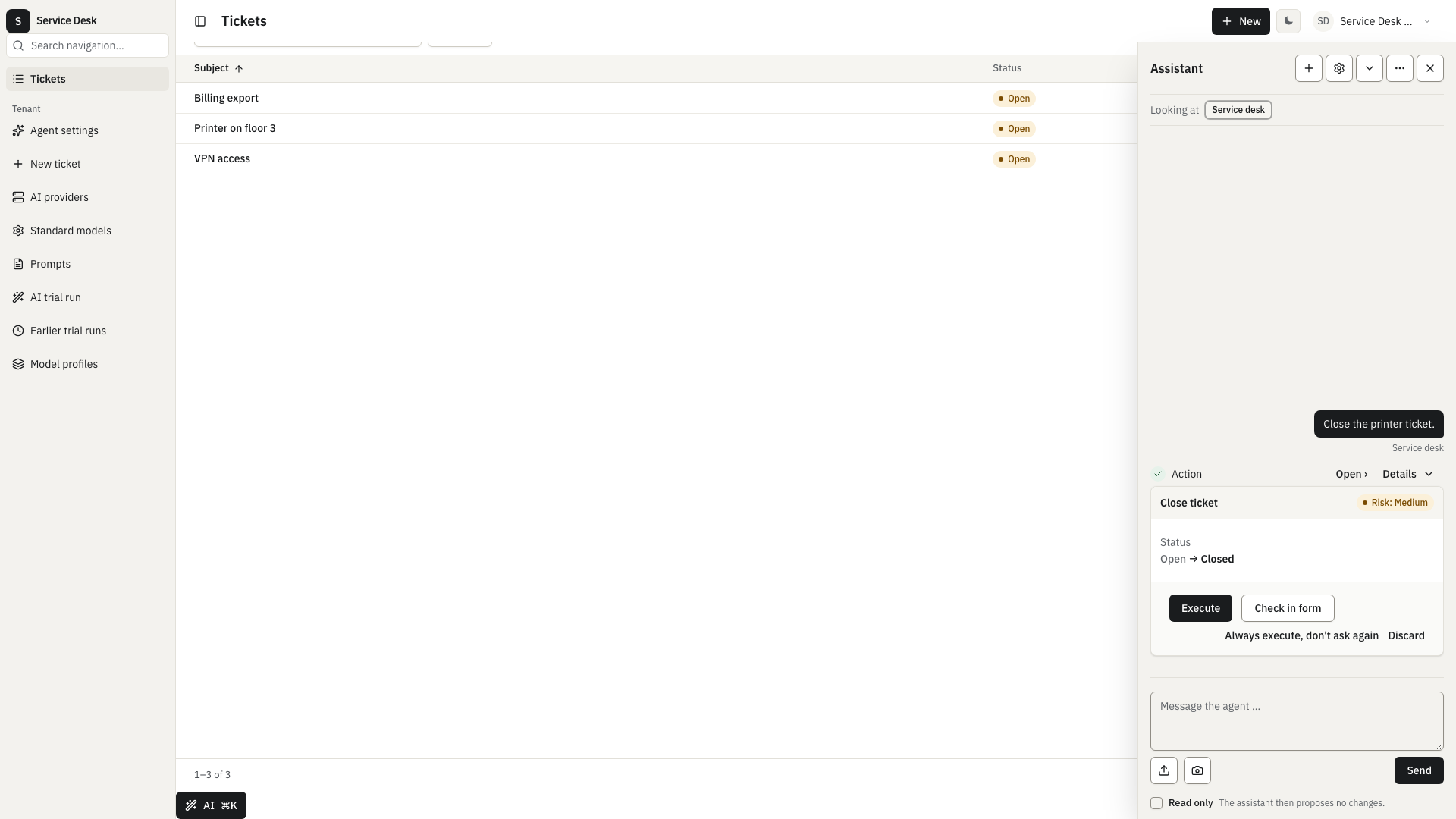
Section titled “In-app AI assistant”ai-agent puts a chat layer over a running app. It reads the same registry the
app is built from, so it can search, open and, with a human approving each
write, change your records. ai-agent-edit is the add-on that lets a low-risk
write run unattended once the user has said “always”.
AI feature-builder
Section titled “AI feature-builder”Generate, refine, and draft with LLMs, the engine behind the visual Designer and the AI authoring flow.
AI providers
Section titled “AI providers”Pluggable LLM backends. A tenant adds connections (OpenRouter is an OpenAI-compatible connection) and picks standard models per job.
Document AI and voice
Section titled “Document AI and voice”Use the same provider boundary for documents and speech. ai-extract turns
text or PDFs into schema-shaped data, while the transcription and speech
capabilities of the AI providers feed voice input into the assistant and read
answers aloud.
The parser providers plug into the open document-ingest-foundation and turn
uploads into text before any AI step runs. Mail from Microsoft 365 comes in
through the open inbound-mail-foundation with the Graph provider.
Build your own version
Section titled “Build your own version”Enterprise is an implementation layer, not a requirement of the framework. You can build an application-specific alternative with the public feature, handler, job, screen, provider, and renderer APIs. For example, an app can use its own LLM client, prompt storage, approval UI, extraction handler, or worker.
The Enterprise packages save that work and provide a maintained composition, but they are not automatically drop-in compatible with a custom implementation. An app-owned version remains responsible for provider integration, access rules, validation, tests, prompt/data handling, security review, and production operations. See the open framework concepts when you want to own that layer yourself.
Pattern storage & publishing
Section titled “Pattern storage & publishing”Store, version, and publish the feature patterns the Designer and AI builder produce.
Advanced renderers
Section titled “Advanced renderers”Richer notification rendering than the open renderer-simple.
Domain features
Section titled “Domain features”GDPR coverage
Section titled “GDPR coverage”Features that keep personal data ship a separate *-user-data feature. It
registers the export and erasure hooks of the open
user-data-rights feature for that
feature’s entities. Mount it next to the feature when your app runs the
user-data-rights pipeline:
ai-agent,
ai-agent-attachments,
ai-conversation,
credit,
pattern-storage, and
prompt-store.