account-security
Self-service account dashboard: MFA enrollment, recovery codes and the user’s own sessions, composed from the auth-mfa and sessions screens.
Quick example
Section titled “Quick example”From recipes-auth-mfa — the smallest working mount:
// Auth MFA (TOTP/2FA) Sample//// Shows the production-wiring shape: mount `createAuthMfaFeature()` next to// `createAuthEmailPasswordFeature()`, thread its status-checker into the// login handler, and (if `sessions` is mounted) bind its revoke-all-other-// sessions callback. From there the framework handles the rest — login// returns a challenge instead of a JWT when MFA is enabled, POST// /auth/mfa/verify completes it, and every OTHER live session gets signed// out whenever the account's MFA state changes (enable/disable/regenerate).//// What to copy into your own app:////   const mfaFeature = createAuthMfaFeature({//     setupTokenSecret: config.mfaSetupSecret,//     challengeTokenSecret: config.mfaChallengeSecret,//     issuer: "Your App",//   });//   const sessionCallbacks = createSessionCallbacks({ db });//   bindMfaRevokeAllOtherSessionsFromFeature(mfaFeature)?.(//     sessionCallbacks.sessionRevokeAllOthers,//   );////   const server = buildServer({//     registry: buildRegistry([//       createAuthEmailPasswordFeature({//         mfaStatusChecker: mfaStatusCheckerFromFeature(mfaFeature),//       }),//       createSessionsFeature({//         autoRevokeOnPasswordChange: sessionCallbacks.sessionMassRevoker,//       }),//       mfaFeature,//       // ... other features//     ]),//     context: { db, ... },//     jwtSecret: config.jwtSecret,//     auth: {//       membershipQuery: "tenant:query:memberships",//       loginHandler: "auth-email-password:[REDACTED:API key param]",//       mfaVerifyHandler: AuthMfaHandlers.verify,//       switchTenantMfaGateHandler: AuthHandlers.switchTenantMfaGate,//       sessionCreator: sessionCallbacks.sessionCreator,//       sessionRevoker: sessionCallbacks.sessionRevoker,//       sessionChecker: sessionCallbacks.sessionChecker,//     },//   });//// Apps built via runDevApp/runProdApp (the dev-server bootstrap) get all of// this for free just by adding `createAuthMfaFeature(...)` to APP_FEATURES —// composeFeatures threads the status-checker and the bootstrap wraps the// session-revoke bind and the /auth/mfa/verify route automatically. This// sample shows the raw wiring contract those helpers implement.//// Design rules the sample demonstrates:////  1. Login becomes two-step once MFA is enabled. `POST /auth/login` returns//     `{ mfaRequired: true, challengeToken }` instead of a JWT; the client//     completes with `POST /auth/mfa/verify`.//  2. Enrollment is stateless until confirmed. `enable-start` returns a//     signed setup token (QR + recovery codes) — nothing is persisted until//     `enable-confirm` proves the user scanned it with a valid TOTP code.//  3. Recovery codes are single-use. Each of the 8 generated codes can//     complete exactly one login challenge, then it's burned.//  4. Every MFA state change signs out every OTHER live session (stolen-//     session defense) — but never the session that made the change.
// One self-service screen for MFA and own sessions. Dormant until `nav` is// set, so apps that mount it only for deep links get no sidebar entry.export {  ACCOUNT_SECURITY_SCREEN_QN,  createAccountSecurityFeature,} from "@cosmicdrift/kumiko-bundled-features/account-security";export {  AuthMfaHandlers,  base32Decode,  bindMfaRevokeAllOtherSessionsFromFeature,  createAuthMfaFeature,  mfaStatusCheckerFromFeature,  userMfaEntity,} from "@cosmicdrift/kumiko-bundled-features/auth-mfa";export { currentTotpCode } from "@cosmicdrift/kumiko-bundled-features/auth-mfa/testing";
📄 On GitHub: samples/recipes/auth-mfa/src/feature.ts
Live preview
Section titled “Live preview”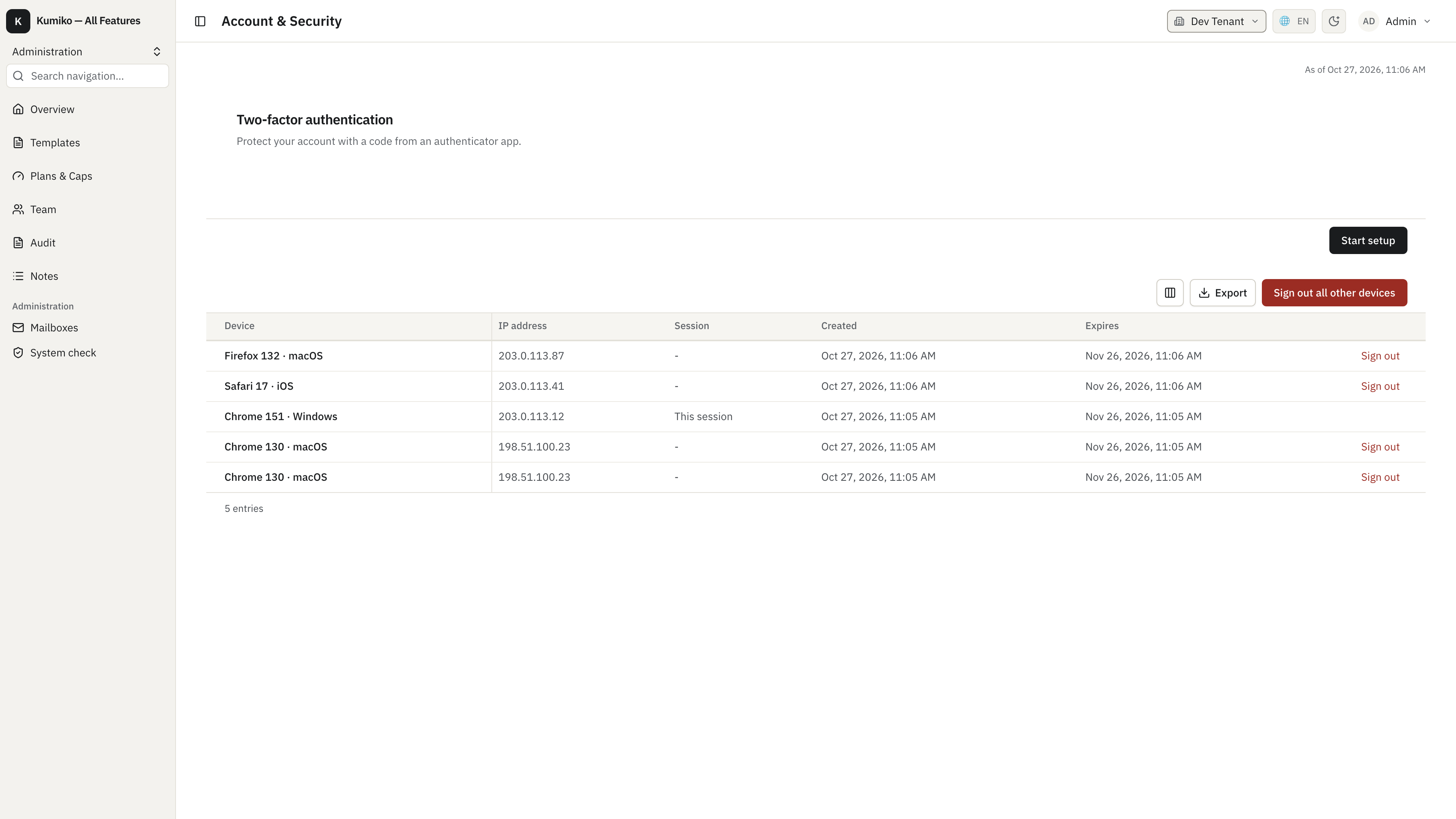
How it fits
Section titled “How it fits”What this feature needs to run (Requires).
flowchart TB
  n_account_security["account-security"]
  subgraph how_reqs["Requires"]
    n_sessions["sessions"]
    n_auth_mfa["auth-mfa"]
  end
  n_sessions --> n_account_security
  n_auth_mfa --> n_account_security
Getting started
Section titled “Getting started”Start with recipes-auth-mfa for a step-by-step walkthrough with runnable code and integration tests.